
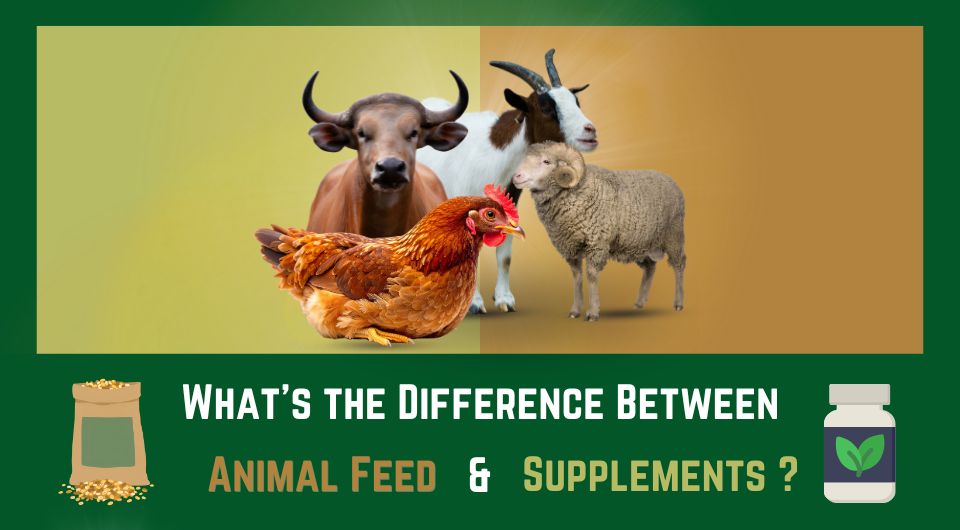
If you ask a number of farmers, you’ll find that the words “feed” and “supplement” frequently are used in the same way, yet they mean completely different things. This confusion is not only a matter of words, it could make a big difference in how well you are providing for your animals’ nutritional requirements, and how efficiently you are using your feed budget.
But if you’re feeding cattle, poultry, swine, horses or pets, it’s important to understand the difference between feed and supplement so you can create the best and most complete nutrition program possible. Let’s break it down pretty easily, and why it will affect the health and productivity of your animals.
What Is Animal Feed?
An animal’s feed is the first food it eats to satisfy its daily energy, protein and general nutritional needs. Forage, grains, silage, concentrates and commercially formulated rations which form the majority of an animal’s diet.
The basic idea of feed is to supply the basic nutrition requirement, adequate calorie, protein, fiber, and overall nutrient provisions for normal maintenance activities, growth, or production requirements of the animal. It is designed with the idea that it will be fed regularly, and sometimes daily, as the sole source of feed.
What Is an Animal Feed Supplement?
A feed supplement has a different purpose, it is not intended to replace the main diet. Rather it is blended into the basic ration to supplement missing nutrients in the basic ration. Supplements are usually supplements of minerals, vitamins, amino acids, probiotics or herbal compounds, and they are fed at relatively low levels compared to the total amount of feed consumed.
Even a well-formulated base diet may not provide adequate amounts of all the nutrients required at certain life stages (such as lactation, growth, breeding, stress and illness), which is why some supplements are necessary. Adjustments to the feeding program should not be an all-out effort to completely revamp the program, but rather to address the gaps through the use of supplements.
Key Differences Between Feed and Supplements
The definition: Purpose means energy and nutrient components of an animal’s diet, and supplements are used to address nutritional gaps or deficiencies in the base diet.
Quantity: Feed is fed in large amounts, sometimes more than supplements, while supplements are fed in small amounts and in a concentrated way.
Formulation focus: Feed is formulated to balance across the calorie, protein and fibre while supplements are formulated to provide specific nutrients (e.g. specific mineral, vitamin or functional compound) at a higher concentration.
Usage pattern: Feed is typically a constant, daily requirement, while supplements may be used continuously, seasonally, or only during specific life stages or health situations, depending on the identified need.
Regulatory classification: In many regions, the regulatory classification of feed and supplements varies significantly. In some parts of the world, supplements are subject to specific labelling and composition requirements due to their targeted and concentrated nature.
Key Differences Between Feed and Supplements
Knowing the difference between feed and supplements is not only a technical detail, it can have practical links to managing your animals’ health and productivity:
- Assuming a good base feed provides all nutrients: Feed formulations are based on average nutrient requirements and may not meet peaks when animals require it.
- Not adding the right amount: On the other hand, giving supplements when there’s no understanding of what is already provided in the base feed can sometimes result in excess intake of some nutrients, which in some mineral cases can be detrimental to the animal’s well-being.
- New approaches to cost management: Working out whether a targeted supplement or a widespread adjustment to the feed programme is more cost effective can help a farm tackle specific problems without the extra cost.
- Better problem solving: When problems in productivity or health occur, finding out if the problem is due to a certain nutritional imbalance or the base feed formulation will lead to a more accurate, effective solution.
Common Types of Feed Supplements
There are several specific types of feed supplements which are used for different specific purposes:
- Mineral supplements: Fill deficiencies of critical trace minerals such as zinc, copper, selenium, calcium, and others that may not be provided adequately in the regular feed and forage.
- Vitamin supplements: Give specific supplementation for vitamins like A, D and E especially at certain production phases or environmental situations.
- Probiotics and prebiotics: Help maintain healthy gut and digestion, especially helpful when switching diets, taking antibiotics or when stressed.
- Herbal and phytogenic: They are supplements that can enhance various aspects of support functions, such as immunity and digestion, and are typically considered natural alternatives to conventional supplements.
- Energy and metabolic supplements: Supply concentrated levels of energy, especially during periods of high energy demand, e.g. transition period for dairy cattle and early growth stages for poultry and swine.

How to Decide If You Need a Supplement
The question of whether or not your animals require a supplement and what type often begins with a more careful examination of your existing feed program. Specific nutrient deficiencies can be identified through forage or feed testing and by monitoring performance parameters such as growth rate, milk production, condition score or reproductive output may indicate specific deficiencies.
Once that point, it generally proves much better to work with a vet or animal nutritionist to pick the right well-formulated supplement correctly than it is to add supplements without any clear insight into what the nutrient deficiency is.
Conclusion
Feed and supplements are different but complementary in the nutrition of animals. Feeding is the backbone of daily energy and nutrient supply, while supplementation can fill in gaps in the diet that are not met even with a good diet – especially during stressful periods in life. This distinction will enable farmers to develop a more accurate and effective nutrition program, without over- or under-supplementing, to ensure proper animal health and productivity.
Frequently Asked Questions
Q: Can a supplement ever replace regular feed?
A: No. Supplements are used to supplement a basic diet and are not meant to be a major component of a daily diet or a diet for the whole animal.
Q: Is it possible to give too many supplements?
A: Yes, over supplementation of any mineral, specifically some minerals, can be toxic. Supplementation should proceed based on needs, not doing so indiscriminately.
Q: Do all animals need feed supplements?
A: not always, but most animals will benefit from targeted supplementation at specific times of their life cycle when the base feed is insufficient, such as during growth, lactation, breeding or periods of stress.
Q: How to determine whether a product is classified as feed or a supplement?
A: In general, products that are intended to be a major part of a daily ration are fed. When it’s taken in smaller quantities and for specific nutrients or functions, it’s a supplement. The distinction can also be understood by reading the product label and the classification of the product.