
All three of these – milk yield, fertility and herd longevity – can be traced back to one common denominator: nutrition. However, with the best breed genetics and management, a dairy herd that is not receiving adequate mineral and vitamin balance and metabolic support will never reach its production potential. With the increased intensity of dairy farming and the narrowing margins, nutritional supplementation has grown from a ‘nice to have’ to an integral component of the successful, profitable dairy farm business with a healthy herd.
Whether you are running a small dairy farm or a large commercial herd, knowing what supplements truly influence productivity, fertility and animal health will have a definite impact on your farm’s bottom line. An easy to understand list of the major nutritional supplement groups that should be of concern to every dairy farm.
Nutritional supplementation is important in dairy farming.
Lactating cows have very high nutritional requirements particularly during the transition period around calving, and at peak lactation. Even when a good basal diet is provided, it may not contain all the micronutrients an animal requires during these stressful periods. That is where targeted supplementation comes into play.
Bad nutrition at these critical times has immediate repercussions on milk production, but can also have long term implications on the animal’s reproductive ability, immune response, and life in the herd. With proper supplementation, it can help fill these voids and aid the animal throughout the production cycle.
Supplements of minerals and trace elements.
Minerals are sometimes referred to as the “silent drivers” of dairy productivity as deficiencies are often not detected until they present as decreased milk yield, poor reproduction or impaired immunity. Look for the following minerals:
- Calcium and Phosphorus: Important for milk production, bones and to prevent such as milk fever in the transition period.
- Magnesium: Important for preventing grass tetany (hypomagnesaemia), especially when animals are eating fresh pastures.
- Trace minerals: zinc, copper, manganese, which have a role in immune function, healthy hooves and enzyme activity throughout the body.
- Selenium: Reproductive health and prevention of retained placenta.
Inorganic forms of the trace minerals are not as well absorbed as chelated or organic forms, so the animal is able to absorb and utilize more of the mineral supplemented in the feed than is excreted unused.
Vitamin Supplements
Most dairy vitamin supplement programmes are based on vitamins A, D, and E which each have a specific role:
- Vitamin A: Functions in vision, reproduction and epithelial integrity, necessary for the defense against mastitis and other infections.
- Vitamin D: With calcium and phosphorus helps in the correct development of bones and lowers the chance of metabolic disorders near calving time.
- Vitamin E: This is a potent antioxidant which along with selenium, plays a role in immune function and helps minimize oxidative stress, especially in the transition period.
B-complex vitamins, specifically biotin and niacin, are also becoming important in the maintenance of healthy hooves and in providing energy support for lactation.
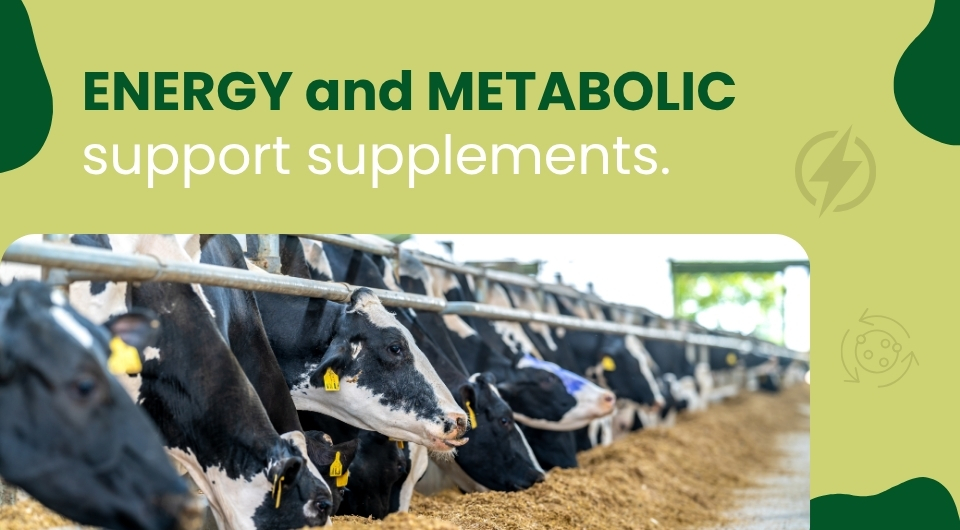
Energy and metabolic support supplements.
Dairy cows tend to be at their most negative energy balance during the transition period (3 wks before; 3 wks after) calving. Milk production requirements exceed the animal’s consumption and digestion capacity causing fat mobilization, which in extreme cases, can result in metabolic disturbances, such as ketosis.
Supplements to aid energy balance during this window may include:
- Rumen protected fats: A concentrated energy source that will not interfere with the rumen fermentation.
- Glucogenic precursors: These are substances that assist in maintaining blood sugar levels when there is high demand, such as propylene glycol or glycerol.
- Choline and methionine: Assist in liver function and fat metabolism, which helps to lower the chance of fatty liver syndrome.
This transition period is a significant influence on the rest of the lactation and is important to manage well, hence the importance of investing in metabolic support supplements for most dairy operations.
To support digestive function and rumen health
An efficient feed conversion depends on a healthy rumen environment. Rumen function supports:
- Live yeast cultures and probiotics: Stabilize pH of rumen and promote bacteria that breakdown fiber, especially important when on high concentrate diets.
- Buffers such as sodium bicarbonate: Assists in controlling the risk of rumen acidosis, particularly in high-producing cows fed diets rich in energy, but low in fibre.
- Prebiotics: Maintain a healthy and balanced ecosystem in the gut that helps in the absorption of nutrients.
Rumen health support investments are often associated with increased milk yield as well as feed efficiency (yield of milk per unit of feed used).
Reproductive and Fertility Support
Fertility is still one of the most expensive problems in dairy production affecting calving interval and herd replacement rates. Helpful nutritional strategies for reproductive performance include the use of a combination of trace minerals (selenium and zinc), vitamin support and, in certain cases, specific fatty acid supplementation to help support uterine health and hormone synthesis.
When the mineral and vitamin program of herds with low conception rates, silent heats, or repeat breeding is examined more closely, it’s often found that there is a gap that has quietly impacted conception rates.

Making a wise choice on the supplement program for your herd
Farm management should not be the same for all farms. What a farm is looking for depends on the animals’ breed, the target level of milk production, the quality of the forage, the soil mineral profile in the area, and various aspects of the health of the herd. One-size-fits-all minerals may be adequate to cover the fundamentals, but often don’t address the specific deficiencies that are limiting a specific herd.
That’s where it helps to work with a herbal and nutritional supplement partner who is knowledgeable about the local feed situation and provides scientifically formulated and quality tested products. Well-researched liquid and powder formulations for certain life stages (e.g. transition, peak lactation, dry period) have greater consistency of performance than patches of generic mineral mixtures. Farms which regularly assess their supplementation program with a qualified veterinary nutritionist are usually better prepared to discover subtle deficiencies before they produce a production loss.
Conclusion
One of the best tools at dairy farmers’ disposal to boost productivity, fertility, and herd health is nutritional supplementation. A properly designed supplementation program is designed to meet the needs of a herd and works on a species-specific basis, as opposed to a “one size fits all” approach. Farms that use a data-driven, life stage-based method of supplementation – preferably with veterinary nutritionist input – often experience the greatest, long-term improvements in milk production and herd life.
Frequently Asked Questions
Q: How will I be able to tell when to implement mineral supplementation to my dairy herd?
A: These are often signs such as decreased milk production, poor conception rates, poor hoof condition or recurring metabolic problems around calving. A blood or forage mineral analysis, in conjunction with a veterinarian, is the best method for determining specific deficiencies.
Q: When should transition period supplements be introduced?
A: Most transition support programs start three weeks prior to calving and last until a few weeks after calving, when there is the greatest metabolic stress.
Q: Can over-supplementation be harmful?
A: Yes. Too much of some minerals (such as selenium and copper) can be harmful. The amount of supplementation should always be related to the real dietary gaps.