
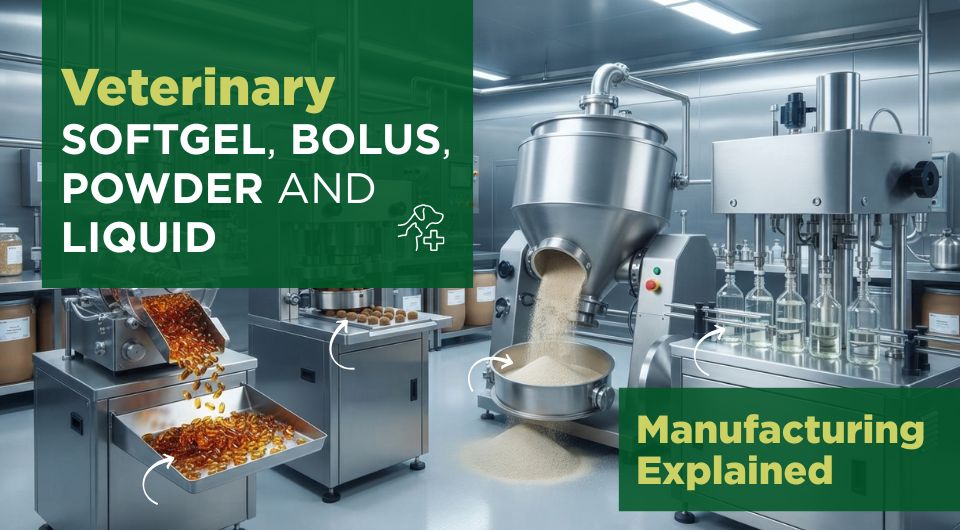
If you are involved in a dairy farm, or a poultry farm or a feed supplement manufacturer, you’ve seen the same active ingredient in four very different formats: softgel, bolus, powder, and liquid. This is not an advertising ploy. They are all made differently, absorbed differently and used for a different feeding situation. Knowing how these 4 forms are produced can help you make informed buying decisions and optimize the results of whichever supplement you select.
We’ll go through the manufacturing process for each format, discuss the benefits of using one versus another, and show you the difference between a good and a bad veterinary supplement.
Why is Manufacturing Format Important in Animal Nutrition?
As a manufacturing decision, format should not be an afterthought; it helps to understand why that is. The correct format is influenced by:
- The physiological condition of the animal (cattle, poultry, or swine or an aquaculture species) being fed — each of these species has a different digestive system.
- Whether to dose as a herd or flock or by individual animals (feed-mix dosing)
- The rate of absorption of the active ingredient
- The storage and transportation characteristics; particularly those of export shipments
- Lighter workload on the farm with convenience in handling.
The manufacturer who is knowledgeable about these factors will create the formulation and format, not just repack the same formulation into different shells.
Powder Manufacturing: The Feed-Mix Workhorse
It’s the most popular format in veterinary and livestock nutrition – for a very good reason. Powder easily blends into feed, is inexpensive to manufacture on a large scale, and is usable on a variety of livestock, from cattle to poultry to aquaculture.
The process of making powder supplements.
Generally, this process includes:
- Raw material sourcing and testing – herbal extracts, minerals and active compounds are tested for purity prior to entering production.
- Micronization or grinding – Ingredients are ground to a uniform particle size and this influences the uniformity of the powder in the feed.
- Uniform potency, as blending is controlled under GMP conditions so that all batches of product are of equal potency, otherwise it would be possible to under dose some animals but over dose others.
- Quality testing and packaging – moisture content, particle size, concentration of active ingredients are checked prior to packing into export quality and/or farm quality packages.
When you are adding supplements to feed troughs, poultry feed or aqua feed, powders are the best option for dosages that are meant for treating the entire herd or flock. Such products as herbal liver support and metabolic support products for cattle are commonly produced in this format and can be dose-determined for large groups of cattle.
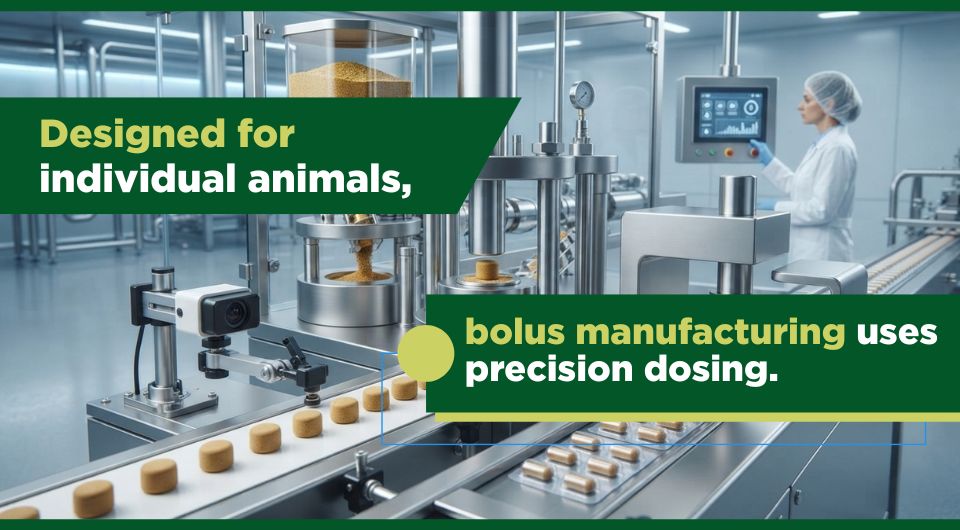
Designed for individual animals, bolus manufacturing uses precision dosing.
A bolus is a large compressed pill which is fed directly into a single animal, typically cattle and buffalo, with a bolus gun. Unlike powder, boluses are prepared for precision, the exact dose is given to each animal.
The Bolus Production Process
- Formulation and granulation – active ingredients are mixed with excipients and binders to make granules that will compress well.
- Compression – granules are compressed under controlled pressure, with the use of special equipment, into a dense bolus in the shape of a cylinder, for veterinary dosage sizes, not humans.
- Coating (if necessary) – some boluses are coated so that the active ingredient is released slowly over a few hours or days, instead of a peak.
- Hardness and dissolution testing – bolus hardness should be sufficient to allow handling but the bolus should dissolve at an appropriate rate in the digestive tract of an animal.
Boluses are particularly helpful when caring for post calving cattle, correcting mineral deficiencies and when certain the farmer wanted a particular animal to take the full dose which is difficult to ensure with powdered feeds.
Softgel Manufacturing: Concentrated, Fast-Absorbing Support
In veterinary nutrition, softgels are not a major conversation, but they have become much more common for the concentrated actives, especially fat-soluble vitamins, oils and herbal extracts for which they are beneficial to encapsulate.
The process of making softgels.
The production of softgels is more complex than powder and bolus production:
- Fill formulation – Active ingredients suspended in an oil or lipid base (softgels are designed to be used for oil-soluble active ingredients).
- Gelatin shell preparation – The preparation and process of creating thin ribbons of shell material from the gelatin (or plant-based) is called shell preparation.
- Encapsulation – using rotary die technology, the fill is sealed between two gelatin ribbons and shaped into individual capsules in a single continuous process.
- Drying and polishing – capsules are dried to the appropriate moisture content and then polished for the final product.
Softgels provide protection from oxidation to sensitive compounds, and allow for more consistent and accurate dosing per unit, particularly beneficial for potent herbs and vitamins which require stability throughout storage and export transportation.
Liquid manufacturing is the speed of absorbing and ease of administration.
Liquid preparations are used when rapid absorption is important or when it is more convenient to administer the product orally as a drink than as a solid preparation, which is often done in poultry and swine.
Liquid Formulation Process
- Solubility testing – all active ingredients must be dissolved or suspended in the selected liquid base and tested to ensure this occurs.
- Mixing and homogenization – Ingredients may be mixed to achieve even distribution of the active ingredients in the liquid, rather than having them settled at the bottom.
- pH and stability adjustment – liquids are more vulnerable to microbial attack and degradation and pH balancing and preservative systems are carefully balanced.
- Filling that is sterile or hygienic – liquids will be filled hygienically and sealed during storage and transport to prevent contamination.
In large poultry sheds where individual dosing is not possible, liquid formulations are suitable for water-soluble tonics and metabolic support formulas that are given through drinking water systems.
What to Look For in a Veterinary Feed Supplement Manufacturer
The quality of the manufacturing process is more important than the format of a supplement. In checking out a manufacturing or private-label partner, you should examine:
- Production facilities with documented and repeatable processes certified as GMP compliant
- Potency, purity and contamination tests by in-house or third-party laboratory
- Batch to batch consistency particularly important for export shipments, where regulatory documentation must be in line with actual product composition.
- Flexibility in format, as a business that only produces powder, won’t necessarily be able to accommodate your entire product mix as your needs expand.
- Experience in export, including experience with documentation and compliance needs to foreign markets
Conclusion
While softgel, bolus, powder and liquid all are used in different ways for different species, different dosing requirements and different situations, there is no universal agreement that one is “better” than the others. When feeding in the herd or flock, powders and liquids are a great option, and boluses are a good choice for feeding individual cattle. Softgels protect and are efficient in delivering concentrated activities. When discussing the advantages of different formats, the best place to start is knowing these differences and asking the right questions at the evaluation stage when considering a manufacturing partner.
Frequently Asked Questions
Q: When it comes to large numbers of poultry, which is the best format?
A: The most practical application of powder mixed into feed or liquid given via drinking water systems is usually for poultry where individual application is not practical at flock level.
Q: Why do boluses take longer to show results than powders?
A: Many boluses are designed for sustained, slow release inside the animal’s digestive tract, which spreads the dose over hours or days rather than delivering it all at once.
Q: Is it possible to produce the same active ingredient in various formats?
A: Yes. Often the same active ingredients may come in a variety of forms: powder, bolus, softgel, or liquid, depending on how it is made, not how it is used.
Q: When selecting a supplement form for the farm/business, what should I look for?
A: Take into account the average size of the herd/flock, if you need to dose an individual or a group, storage conditions and how soon you want the active ingredient to be effective.