

Whether you are running a broiler farm to get your birds to grow quickly, or a layer farm with the aim of a consistent egg laying performance, growth performance is one of the largest factors that will determine profitability. Growth promoters have been a significant factor in improving the ability of birds to use feed for growth or production of eggs for many years. However, the growth promoter market has evolved considerably in recent years and there is a definitive shift in the world towards using herbs and natural growth promoters that do not contain antibiotics.
In this article, the author describes what growth promoters are, the reasons for the industry’s pursuit of herbal products and how to harness them as an integral part of a modern poultry nutrition program.
What are Growth Promoters in Poultry Farming?
Feed additives that are added to improve the growth rate or the feed to body weight conversion ratio (whether that be meat production in broilers or egg production in layers) are called growth promoters. Typically, this class was represented by antibiotic growth promoters (AGPs) that did at least part of their job by inhibiting growth of undesirable gut bacteria so that the bird could put more effort into growing.
However, the issue of antibiotic resistance has raised awareness by the poultry industry for looking at alternatives that provide similar performance without the risks. Animal by-products (ABPs) are increasingly restricted or banned from use in animal nutrition in many countries due to new regulations.
Why the Shift Toward Herbal and Natural Growth Promoters
The shift away from ABP is not a matter of regulation, it’s a matter of concern about how antimicrobial resistance could move from animal agriculture to the health system. Meanwhile, consumer pressure has increased to get rid of antibiotic use in chicken products, while commercial pressures continue to weigh on farms seeking to find a viable alternative.
Herbal and phytogenic growth promoters are one of the most promising alternatives as they are based on plant extracts, essential oils and other natural extracts that have a different mechanism of action than antibiotics and are able to provide the same growth performance benefits by helping to maintain gut health, digestion and immune function.

How Herbal Growth Promoters Work
Herbal growth promoters do not act in the same way as antibiotics by inhibiting bacteria, but they usually have a number of different effects:
- Better gut health: Several herbal ingredients promote a healthy gut, encouraging good bacteria to flourish while naturally inhibiting harmful bacteria.
- Improved digestibility of feed: Some of these plant extracts boost digestive enzyme production, enhancing the digestibility of feed by the birds.
- Appetite stimulation: some herbs contain ingredients that can make feed more palatable and help stimulate appetite so it is more consistent.
- Antioxidant and immune support: Phytogenic compounds with antioxidant properties can minimise oxidative stress in birds and thus benefit bird health, indirectly affecting growth performance.
Common herbs found in poultry growth promoter formulations contain oregano, thyme, garlic, turmeric and other herbs that are both traditional and modern, well-known for their digestive and immune stimulatory properties.
The advantages of growth promoters in poultry are:
Growth promoters (especially herbal growth promoters) have several measurable benefits when used correctly in a well-rounded nutrition program:
- Better feed conversion ratio (FCR): Efficient nutrient digestion and absorption can reduce the amount of feed needed for a given amount of weight gain, which positively impacts farm profitability.
- Better and more even gains: More consistent weight gain throughout a flock with support for gut health and digestion can help to minimize variability and make management and marketing easier.
- Lesser reliance on antibiotics: This allows farms to move towards less reliance on antibiotics, a value increasingly desired by regulators and consumers.
- Better livability and reduced mortality: Improved gut and immune health can translate into fewer subclinical infections and lower overall flock mortality.
- Better egg production in layers: In layers the improvements in egg output and shell quality can be sustained throughout the production period.
Conservation and the Use of Growth Promoters Effectively
The benefits of growth promoters are highly reliant on the correct use, timing and incorporation into the overall feed program. There are a few things to keep in mind:
- Early brooding: Introducing growth and gut-health support from early brooding stages will impact the long-term than if introduced at a later stage in the production cycle because gut development during early brooding stages plays a significant role in long-term performance.
- Adjust the dose of the product to fit your production program: The nutritional needs of the broiler production phase (starter, grower and finisher) are different and the dose of the product should vary depending on the production stage, not a flat dose of the product.
- Mix consistently: Inconsistent mixing in feed may result in uneven doses being applied to a flock reducing the efficiency of the dose. In smaller or medium sized operations, liquid or water soluble powder may offer a more uniform application.
- Used in conjunction with good management practices: No growth promoter can overcome poor ventilation, poor mixing or overcrowding, or irregular feeding and drinking. It will be most effective when used in conjunction with other management measures, and not as a single solution.
- Track performance data: Before and after using a growth promoter, be sure to track FCR, body weight gain and mortality rates to confirm that it is effective for the specific flock and conditions.
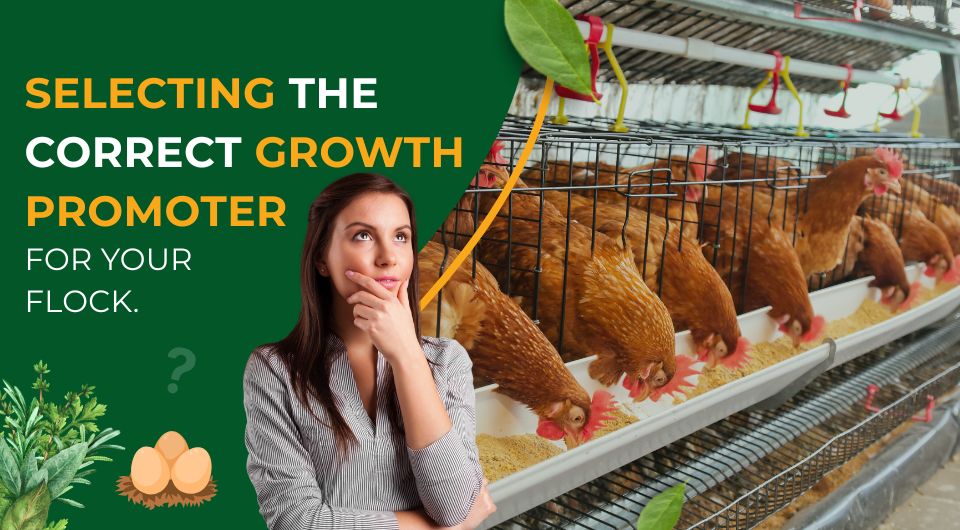
Selecting the correct Growth Promoter for your flock.
Herbal growth promoters do not come in the same form and some may contain more, different or lower levels of active ingredients. An effective scientifically-based phytogenic formulation, which undergoes the proper quality testing, is more likely to produce some measure of success as compared to random herb mixtures that do not have the proper levels of active ingredients.
A consistent response is generally achieved with a supplement that has experience with the species and has expertise to advise dosage throughout the different stages of production, rather than simply one based on price. Farms that regularly go back to their growth performance data with their veterinarian or nutritionist usually have a better chance of adjusting their supplementation program over time.
Conclusion
Growth promoters remain a valuable tool in poultry farming, but the shift from antibiotic-based to herbal and phytogenic alternatives reflects a broader, necessary evolution in how the industry approaches bird health and productivity. If used appropriately and with a thorough selection process, and in conjunction with good flock management, herbal growth promoters can help to achieve substantial reductions in feed conversion, better growth uniformity and flock health, whilst contributing to the industry’s drive towards more sustainable, antibiotic-free production. With scientifically formulated herbal solutions such as those offered by Varahvet, poultry farmers can confidently support bird performance while aligning with modern, responsible farming practices.
Frequently Asked Questions
Q: Do herbal growth promoters work as well as antibiotic growth promoters?
A: Increasingly, research has shown that herbal and phytogenic growth promoters can be effective alternatives, especially for gut health, digestion and feed conversion, results may vary according to the quality of the formulations and farm management.
Q: At what age should growth promoters be introduced to broilers?
A: Many farms start feeding young stock gut health and growth at a brooding stage, because early digestive development has an important effect on lifetime performance.
Q: Can growth promoters be used alongside vaccination and other health programs?
A: Yes, in general, herbal growth promoters can be used in conjunction with conventional vaccination and health management programmes, but it is recommended that any new feed additive be used in consultation with a veterinarian.
Q: Do growth promoters affect egg quality in layers?
A: Growth and gut-health promoters, when correctly formulated and used as appropriate, can help maintain consistent egg production and egg quality (shell), but this varies according to the type of growth and gut-health promoter and the overall flock management.