

One of those cattle management areas which is easy to overlook is mineral nutrition, especially because mineral deficiencies can often occur for years without a dramatic obvious symptom becoming evident. Rather, they manifest slowly as a decrease in milk production, lack of luster, minor fertility problems, or simply growth that doesn’t meet the target. Once you start seeing these symptoms, a mineral deficiency could have been present in your herd for weeks or months without you realizing it.
It explains the importance of each of the minerals in cattle nutrition, why they are important and how to consider developing a mineral supplementation program that makes good sense and fills in mineral deficiencies in the basal feed.
How Mineral Nutrition Can Be the Last Thing You’re Missing
The energy and protein requirements are generally the easier to monitor and are normally the most obvious factors determining growth and milk production in the diets of ruminants, whether on pasture, silage or a combined ration. The minerals however, are required in very small quantities but are responsible for almost all of the physiology such as the development of bone, immune functions, reproduction and enzyme activity etc.
Even a diet that seems well balanced may leave significant gaps in soil mineral supply due to soil depletion, differences in the mineral content of forages in different regions, and seasonal changes in pasture quality. That’s why mineral supplementation is no longer “optional” but is now a key element of today’s cattle feeding program.
Minerals required in large amounts – macrominerals.
All the macrominerals are needed in relatively higher quantities, and are the backbone of most cattle mineral supplementation programs:
- Calcium: Needed for milk making, muscle action, and bone growth. Calcium deficiency is especially noted around calving, and is directly associated with milk fever, a serious metabolic disease of newly calved cows.
- Phosphorus: Helps calcium in bone development and is important to metabolism of energy and reproduction. The calcium to phosphorus ratio is as important as either the calcium or the phosphorus amounts, because an imbalance between the two can cause problems even with sufficient total amounts of both.
- Magnesium: It is essential for preventing grass tetany (hypomagnesemia), a possible fatal disease, especially linked to cattle grazing on rich, fast-growing spring pastures that are naturally low in magnesium.
- Sodium and chloride: The basic salt needs for fluid balance, nerve function and general metabolism, and are probably the most easily corrected mineral deficiency with a simple salt supplementation.
- Potassium: Most forages are good sources of potassium except in special situations such as heat stress or feed formulation, which may result in the development of potassium deficiency and compromise muscle and nerve function.
The small quantities of minerals which play a large role in health and disease.
Other minerals (trace minerals) are required in much smaller amounts, but are no less critical, particularly as their deficiency may impair immunity, fertility and the overall resistance of the herd without the owner being aware of the problem.
- Zinc: Helps with immunity, hooves and skin integrity. Zinc deficiency is associated with decreases in the condition of the hooves and increases in susceptibility to infection.
- Copper: Part of enzymes, coat pigment, immune function. Sometimes, copper deficiency is characterized by dull, dry hair and lowered fertility rates; however, it is important to monitor copper levels because copper toxicity is also a possibility.
- Selenium: plays a role with vitamin E to help immune health and reproductive health. A correlation between selenium deficiency and retained placenta and white muscle disease (WMD) in calves, especially in areas with selenium low soils, is well established.
- Manganese: Aids in the formation of bones and reproductive function, deficiency associated with reproductive problems and skeletal deformities in calves.
- Iodine: Important for thyroid function and metabolic control, especially during pregnancy when it can impact calf development.
- Cobalt: Indirectly essential for energy metabolism because of its requirements for vitamin B12 production by rumen microorganisms; for overall vitality.

Familiarize yourself with not only the quantity of minerals, but also their form.
The mineral content in itself is not the essential factor, so much as the form in which minerals are supplied, which will also have a significant impact on the uptake and utilization of minerals by cattle. Inorganic mineral sources are usually cheaper and less bioavailable than organic or chelated mineral sources that are chelated to proteins and are better absorbed.
In some cases, farms with specific and persistent deficiency symptoms, even when given adequate mineral supplementation, might be better served by changing to more bioavailable organic mineral forms, especially for critical trace minerals such as zinc, copper and selenium, than by simply increasing the amount of a less bioavailable inorganic mineral source.
The minerals most needed during each stage of life.
The level of mineral needs is not constant during a cow’s production life. Several of these periods will be of special interest:
- The transition period: The last few weeks before and the first few weeks after calving is a period of increased calcium and magnesium requirements for the cow’s system, and is the most important time to avoid metabolic abnormalities such as milk fever.
- Peak lactation (hydroponic): Mineral requirements increase significantly to maintain high levels of milk production, especially calcium and phosphorus.
- Breeding season: Trace minerals like selenium, zinc, and copper play a significant role in reproductive success, making adequate supplementation ahead of and during breeding season particularly important.
- Growing calves: Skeletal development during early growth depends heavily on adequate calcium, phosphorus, and trace mineral intake to support long-term structural health and productivity.
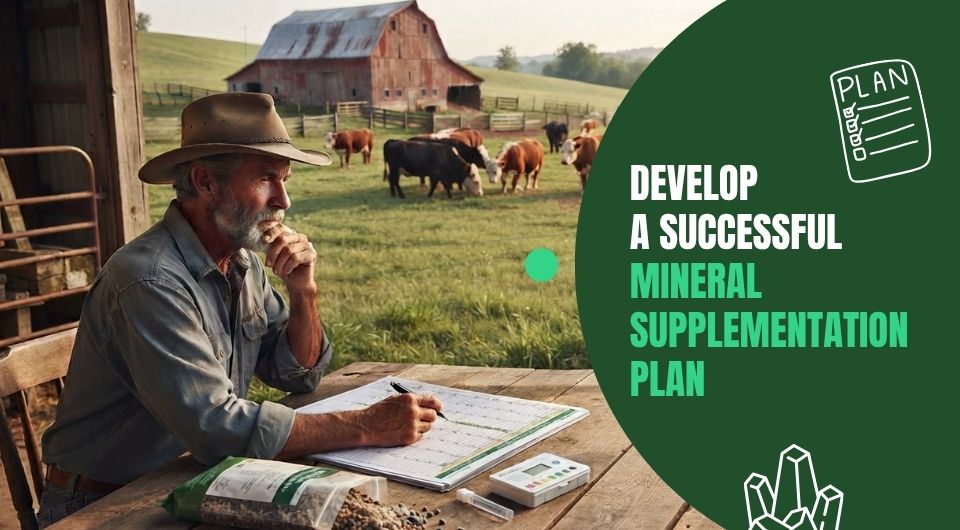
Develop a Successful Mineral Supplementation Plan
Because mineral needs can vary from pasture to pasture, forage to forage and production stage to production stage, an effective mineral program begins by knowing what the forage or pasture is supplying in a specific situation, preferably by having it tested, versus relying on a generic, one-size-fits-all mineral mix to fill in all the needs. Based on that, targeting the most critical deficiencies identified, through the use of forms that are bioavailable and formulated for the life stage the animal is in, can yield a lot more predictable results than generic supplementation.
The use of a mineral supplement formulated with special consideration of bioavailability and species-specific requirements by a regional expert on cattle nutrition (such as VarahVet) in conjunction with working closely with a veterinarian or animal nutritionist will generally result in better measures of herd health and productivity than generic unbranded mineral blocks.
Conclusion
While nutritive minerals may not seem to be a large part of the diet, they actually make up a much larger part of the cattle’s health and productivity. These needs can be met properly: with the right amounts, in the right form, and not only for immune health, but also for reproductive success, milk production, and all other things in between. The forage testing and a comprehensive, life-stage appropriate mineral program, from an experienced nutrition partner like Varah, are best suited to identify and correct mineral deficiencies before they sneak up on the farm and take a toll on herd performance.
Frequently Asked Questions
Q: How can I tell if my cattle are deficient in any minerals?
A: Several signs may indicate mineral deficiencies such as a dull coat, poor condition of the hooves, a decrease in milk production or fertility. The best confirmation is through forage testing and blood tests (with a veterinarian).
Q: Do most cattle herds require a mineral block?
A: It can be used to meet basic needs but generic blocks will seldom meet gaps that exist at the regional or life stage level. Taking forage samples and changing the supplementation as needed will generally yield better results.
Q: Can too much mineral supplementation be harmful?
A: Yes, especially minerals such as copper and selenium which can be toxic when taken in large amounts. It is important that supplementation is based on individual needs not on a set amount.
Q: Why are minerals sold in organic forms more expensive and worth it?
A: Organic or chelated minerals cost more due to their processing, but their improved bioavailability often means better absorption and results, particularly for critical trace minerals, potentially offsetting the higher cost through improved herd performance.